
Master Chief: A Local-First SOP-Driven Assistant for Workflow Automation
Master Chief is a local-first assistant runtime built to automate structured workflows. It currently powers a daily WordPress blog pipeline, but it is not limited to content creation. The same architecture can support many future workflows, from research and reporting to admin tasks, notifications, publishing, and other repeatable processes.
What Master Chief Does
Master Chief runs workflows defined as SOPs, or standard operating procedures. Each SOP describes a sequence of steps the assistant should follow, and the runtime advances through those steps while tracking state, storing artifacts, and pausing when human approval is needed.
Today, that includes a daily blog workflow:
- Collect topic ideas.
- Select a topic.
- Research the topic.
- Draft the article.
- Generate an image prompt.
- Review the content.
- Wait for Telegram approval.
- Publish to WordPress.
- Clean up temporary artifacts.
But that is only the first use case. Master Chief is designed as a general workflow engine, not a one-off publishing script.
Why It Exists
The goal is to make automation predictable, resumable, and easy to extend. Instead of hardcoding logic for one task, Master Chief uses SOPs so new workflows can be added without changing the core idea of the system.
That means the same engine can eventually run very different automations:
- research pipelines
- editorial workflows
- publishing updates
- report generation
- internal admin tasks
- notification workflows
Architecture Overview
Master Chief is built in Rust and organized around a few core pieces:
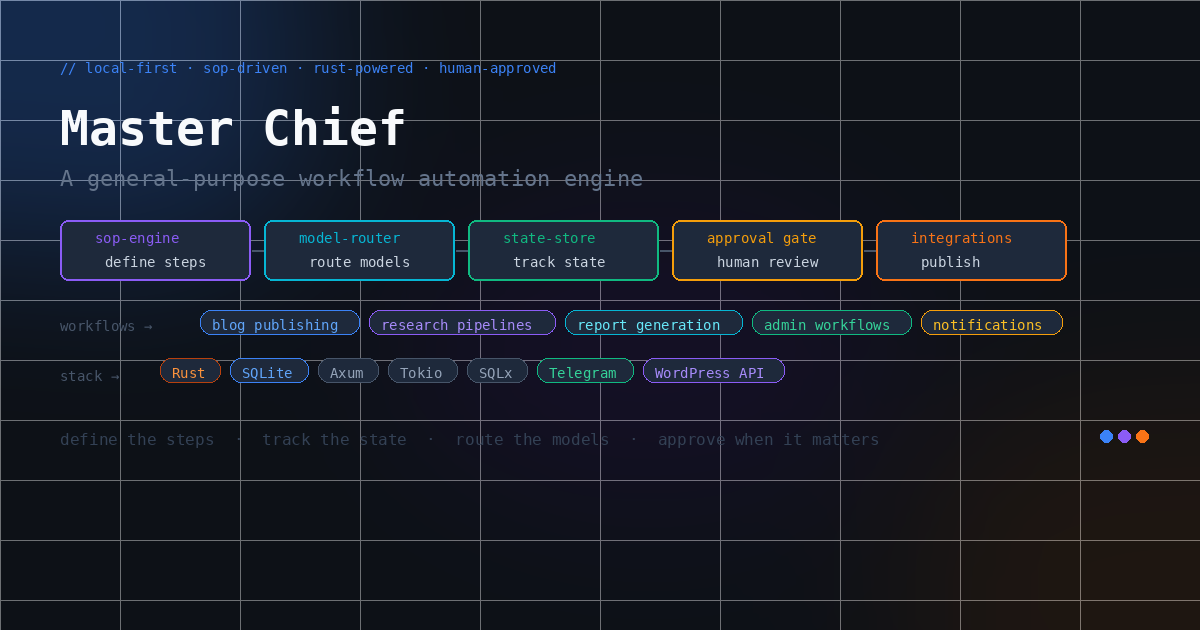
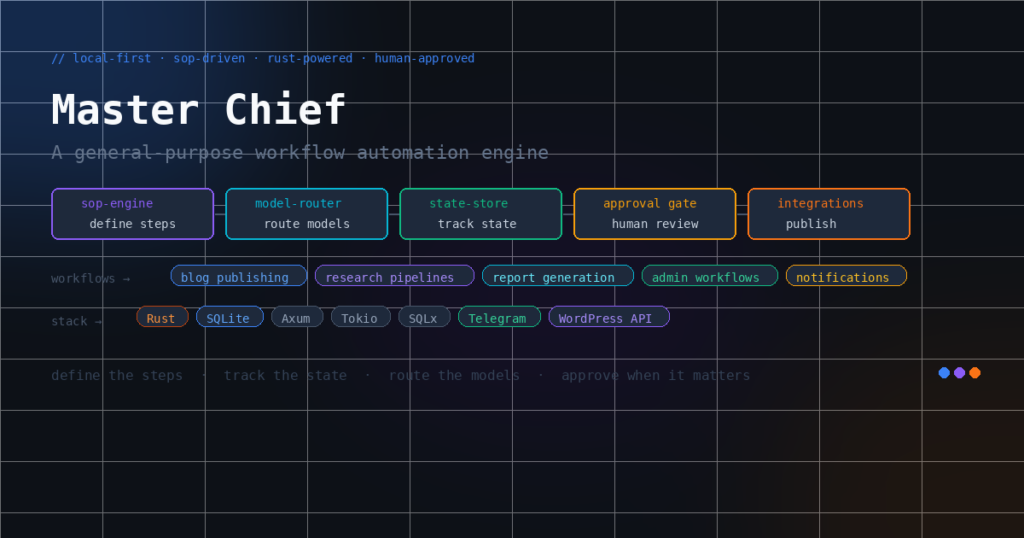
assistant-corehandles command entry and runtime flow.sop-engineloads and advances SOP definitions.tool-registrycovers actions like drafting, review, Telegram, and WordPress.model-routerchooses the right model per step.state-storepersists workflow runs in SQLite.artifact-storekeeps drafts, prompts, and logs.integrationsconnects external services like Telegram and WordPress.
The system is local-first today, with PostgreSQL planned later if the project grows.
Tech Stack
Master Chief uses:
- Rust 2021/2024
- SQLite for local persistence
- SQLx for database access
- Axum for webhook and future UI support
- Clap for CLI commands
- Serde for config and SOP schemas
- Reqwest for HTTP clients
- Tokio for async scheduling
- Telegram Bot API for approval gates
- WordPress REST API for publishing
Workflow Design
The key design choice is that workflows are defined explicitly, not buried in code. Each SOP can specify:
- the trigger
- the ordered steps
- the model profile for each step
- the parameters needed for execution
That makes workflows deterministic and easy to reason about. It also makes the system flexible enough to support many kinds of automations over time.
Human Approval
Master Chief includes Telegram-based approval gates so important workflows can stop for review before they continue. That keeps automation fast without removing human control.
Why This Matters
This architecture works well because it balances automation with control:
- SOPs make workflows repeatable.
- SQLite keeps setup simple.
- Rust makes the runtime reliable.
- Model routing allows step-specific AI behavior.
- Telegram approval adds a human checkpoint.
- WordPress integration turns output into a real published result.
Closing
The daily blog workflow is just the starting point. Master Chief is being built as a general-purpose workflow assistant that can grow far beyond content. As new SOPs are added, it can support many different automation tasks using the same core pattern: define the steps, track the state, route the models, and let humans approve when needed.